The Debrief: Spy Fiction's Quietest Interrogation
The agent comes home and is asked to account for himself by his own side. It is the least violent scene in espionage fiction and often the most frightening.
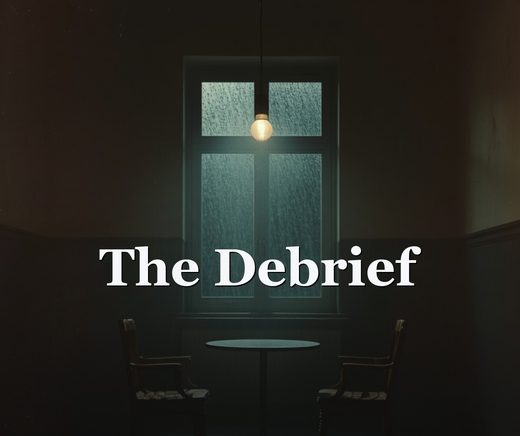
The border crossing is over. Nobody is being followed. The man has come back, and the reward for coming back is a room with two chairs in it and somebody from his own service sitting in the other one, asking him to go through it again from the beginning.
The debrief is the least cinematic scene in espionage fiction. There is no weapon on the table and no threat that anyone would recognize as one. It is also, reliably, the scene that makes a reader's hands cold.
Being asked to account for yourself by your own side
An interrogation by the opposition has a clarity to it. The lines are drawn, the stakes are legible, and a man under questioning by an enemy knows exactly what he is doing there. He can be brave. Bravery is available to him as an option.
The debrief withdraws that option. The person across the table is a colleague. They share an employer, a canteen, possibly a training course from twelve years ago. The questions are procedural and the tone is mild, and underneath both sits a proposition nobody will say aloud: that the service is no longer certain the man in front of it is the man it sent. He cannot refuse to answer without confirming the suspicion. He cannot answer too fluently without confirming it either.
An enemy wants to know what you did. Your own service wants to know who you have become, and there is no honest answer that entirely settles the question.
The failure is always fluency
The craft detail that makes these scenes work is a small one, and it recurs across the best books in the genre. A man telling the truth about a bad week does not tell it well. He loses days, contradicts himself about a bus, remembers the wrong hotel and then corrects it an hour later for no reason. Real memory is a shambles.
The man who has been turned, or who is protecting somebody, has rehearsed. His account is clean. He has an answer ready before the question is finished. And the person debriefing him is listening for exactly that: not for a lie, which is difficult to catch, but for the absence of the ordinary confusion that a truthful account should contain. In the Marcus Vane books this is the whole architecture of the tension. The Warsaw Revenant turns on a returned man whose story is slightly better organized than a returned man's story ought to be, and everybody in the room understands the problem long before anyone is willing to name it.
What the room is actually for
There is a second purpose that a good novel makes visible, and it is bureaucratic rather than investigative. The debrief produces a document. Somebody will write it up, somebody will file it, and in four years an officer who has never met either man will read that file and make a decision about a career on the strength of a paragraph.
That is why the scene has weight out of all proportion to its action. The agent is not fighting for his life. He is fighting for the version of himself that will exist on paper after he leaves the room, and that version will outlive every person who was in it. The service does not need to conclude he is a traitor. It only needs to record that the question came up.
The one who asks the questions
The debriefer is one of the genre's quiet pleasures because the job attracts a specific kind of person: patient, unhurried, entirely without appetite for drama. They tend to be older than the man they are questioning and less impressive on first meeting. They circle back. They ask about the weather, the meal, what time the shop shut, and the trivia is not padding at all. Verifiable detail is the only lever they have, and a rehearsed account is usually strongest at the middle and thin at the edges.
The best of them do something crueler than accusation. They let the silence run and allow the returned man to fill it, on the sound principle that a nervous person will eventually volunteer the thing nobody asked about.
Why it stays with a reader
The reason the debrief outlasts the chase scenes in memory is that it is the one part of espionage fiction most of us have actually lived. Almost nobody has crossed a border on false papers. Everybody has sat opposite somebody at work who was being extremely pleasant while establishing whether they still trusted you. The genre simply raises the stakes on a conversation the reader already knows the shape of, which is why the pulse goes up over nothing more dramatic than a man being offered a second cup of tea.
The Lisbon Exchange opens the Marcus Vane series and is free, if the idea appeals. It is a Cold War novel far more interested in what happens in offices than in what happens on rooftops, which is the correct proportion.
Brian Courrier writes gothic crime, espionage and science fiction. Browse the collection or start with a free book.