Drowned Village Gothic: Why the Lake Remembers
Drowned village gothic fiction has no curse, only a committee. Why flooded valleys make the genre's most haunting setting, and which books to read first.
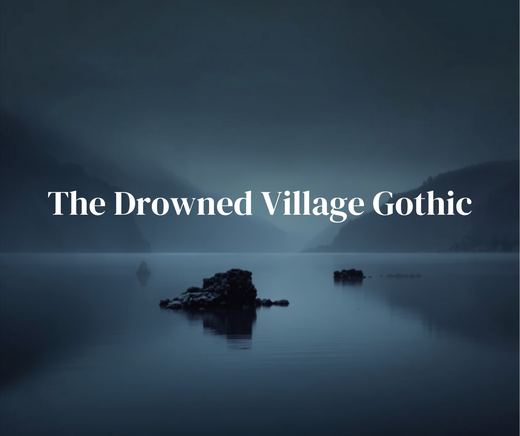
There is a particular kind of quiet that only exists over deep water. You stand at the edge of a valley lake on a grey afternoon, and the surface is so still it looks solid, and somewhere underneath it there is a church, a schoolhouse, a road that used to lead somewhere. Nobody drowned. Everybody left. And somehow that is worse.
Drowned village stories have been quietly haunting readers for over a century, and they are having a moment again. Not because they are frightening in the jump-scare sense, but because they touch something most ghost stories never reach: the grief of a place that was erased on purpose, by people who filed the paperwork correctly.
Why the water changes everything
The classic gothic house works because it is a container. Walls hold secrets. Doors can be locked. There is an attic, a cellar, a wing nobody uses. The architecture itself does half the work of the dread.
Water removes all of that and replaces it with something far more unsettling: distance you cannot cross. The village is right there. You can see the tip of the steeple on a dry summer when the reservoir drops. You can stand on the shore and know exactly where your grandmother's kitchen was. And you cannot get to it. Ever. The haunting is not that the past is hidden. It is that the past is visible and permanently out of reach.
That is the emotional engine underneath a novel like The Drowned Glen, where the lake is less a setting than a witness. The valley remembers what the records were carefully written to forget, and the story works because it never asks you to believe in anything supernatural. It only asks you to look at the water and think about what is underneath it.
The paperwork is the monster
Here is what separates a drowned village story from a standard haunting: there is no curse. There is a committee.
Someone drew a line on a map. Someone calculated a compensation figure that was technically fair and morally obscene. Someone sent a letter with a deadline on it. The families packed. The bulldozers came for the roofs, because a submerged roof is a hazard to boats. Then the sluice gates closed and the valley filled over eleven months, and the whole thing was reported in the local paper as progress.
That is the horror. Not malice, but procedure. Not a villain twirling a moustache, but an engineer doing a competent job and a clerk filing the objection letters in a drawer nobody opened again. Gothic fiction has always been about power dressed up as respectability, and the reservoir scheme is that idea made literal: an entire community, legally dissolved, quietly flooded, and remembered mostly as a nice place for kayaking.
The returning descendant
The genre almost always needs someone who comes back. A granddaughter with a box of letters. A hydrologist assigned to a routine survey. A man who inherited a cottage on the shore and cannot explain why he already knows the road layout underneath.
They arrive with a modern person's assumptions and slowly lose them. Not to ghosts, usually. To documents. To an old woman in the village pub who goes quiet at the wrong question. To the discovery that the official record and the human record do not match, and that the gap between them was created deliberately by people who are still alive and still respected.
The cousins in the genre
Once you notice the pattern, you start seeing its relatives everywhere. The Cleared Island runs the same current through a different landscape, where the emptying was done by eviction rather than engineering, and the sea did the rest. The dread there is not about what appears in the fog. It is about the arithmetic of who was considered worth relocating and who was simply told to go.
Then there is the shoreline haunting, where a single building survives at the edge of the erasure and absorbs all of it. The House on the Lough works that way, and so does The House Below The Tide, which trades the freshwater valley for a tidal one and gets a rhythm the reservoir book cannot: twice a day, the past comes back and shows you its foundations, and twice a day it goes under again.
What all of them share is patience. These are not books that sprint. They accumulate. Chapter by chapter the water level rises in the reader's chest until the final act arrives and you realise you have been holding your breath since somewhere around page ninety.
Why we keep reading them
I think it is because most of us are carrying a drowned village of our own.
There is a house you cannot go back to. A version of your family that existed before a decision got made. A street that has been redeveloped so thoroughly that standing on it feels like standing on someone else's memory. You cannot visit any of it. You can only stand at the edge and know it is down there.
Gothic fiction has always been better than realism at handling this particular ache, because realism insists on explaining and the gothic is content to let something remain unresolved and cold and true. The drowned village gives that feeling an address. It says: yes, it is still there, intact, exactly as you remember it, and no, you are never going to touch it again. Somehow, being told that plainly is a relief.
And there is the quieter satisfaction underneath it all — the moral one. These books insist that the record was wrong. They go back and count the people the report did not count. In a genre that gets accused of being morbid, that is a surprisingly generous impulse: the refusal to let a place be forgotten just because forgetting it was convenient for someone.
Where to start
If this is your first drowned valley, start with the lake. Read The Drowned Glen on a rainy evening with the lamp on and nothing scheduled for the morning, because the last sixty pages do not permit bookmarks. Then move outward to The Cleared Island when you want the same dread with salt in it, and finish at The House Below The Tide if you want to be genuinely unable to sleep.
Read them in autumn if you can. The genre wants low light and the sound of rain on a window. It wants you slightly cold. It wants you to finish the last page, sit still for a minute, and then go looking for the name of the nearest reservoir to your childhood home — just to check.
Every one of these is waiting in the PMV Publishing shop, along with the rest of the gothic and suspense shelf. Pour something warm, pick your valley, and let the water close over your head. We will see you on the other side of it.
Brian Courrier writes gothic crime, espionage and science fiction. Browse the collection or start with a free book.