The Effects of the Deceased: Reading a Life by Its Leftovers
A dead person cannot be interviewed, but their belongings can. Why the inventory of a household is one of crime fiction's most efficient character studies.
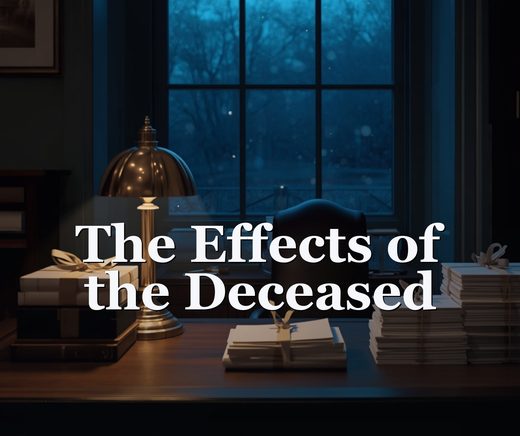
There is a phrase that appears in probate paperwork and almost nowhere else: the effects of the deceased. It means the coat, the reading glasses, the tin of buttons, the shoes at the bottom of a wardrobe. It is a legal category, and it is also, if a novelist is paying attention, a complete portrait of somebody who is no longer available for questioning.
The only witness who cannot be coached
Everyone else in a mystery is performing. The relatives have arranged their faces, the neighbors have decided what they saw, and even the honest ones are unconsciously editing themselves toward a version they can live with. Objects do none of this. They were not arranged for an audience because the person who arranged them did not know anyone would be looking.
So the drawer that has been tidied recently means something. So does the one that has not. A woman who kept forty years of correspondence and burned six months of it has told you which six months mattered, without saying a word about their contents. The Thrushmere Inquests work almost entirely in this register: a death produces an inventory, an inventory produces a list, and somebody eventually notices that an item on the list has no business being in that house.
A house cleared after a death is a statement nobody meant to make, which is exactly why it is worth reading.
The thing that is too new
The classic move is the object out of period. Everything in the room has aged together, worn evenly, faded on the same side, and then there is one thing that has not. A coat too good for the wages. A single expensive item among modest ones, or the reverse, one shabby survivor in a house of new things. The reader does not need a paragraph of explanation. The wrongness registers immediately, the way a wrong note does.
The subtler version is absence, and it is harder to write because the reader must be made to notice something that is not on the page. A set with one piece missing. A photograph album with a gap. Ten years of diaries and no eleventh. The detective's real skill in these books is not deduction so much as inventory: knowing what a household of that kind ought to contain, and registering the hole.
The people who come to divide it
A clearance is also the fastest character study available to a novelist, because nothing exposes a family like the distribution of small objects. The relative who arrives with a list. The one who takes nothing and is furious about it. The one who wants only a chipped jug and cannot explain why, and is not lying. Sons and daughters who have been polite to each other for thirty years discover in an afternoon that they remember entirely different households.
This is why The Clearance at Cawdermere begins where it does. The crime, when it arrives, arrives through the paperwork, and the paperwork is generated by ordinary people deciding what a life was worth in items. Nobody has to be sinister for the process to turn ugly.
What the coastal books do with it
Gothic fiction takes the same instinct and lets the objects outlast the family. A house that has not been cleared in three generations is a very different problem: the effects of the deceased are still there, mixed with the effects of two earlier deceased, and nobody now living can say which drawer belongs to whom. The Tide House books make good use of this, because a coastal house that is never emptied simply accumulates until the past is stored in the same cupboard as the present.
The horror is not a ghost. It is the recognition that somebody who died in 1911 is still deciding where things go.
Why the device never tires
It survives because it is true, and readers know it is true. Almost everyone has eventually stood in a room deciding what to do with a dead person's things, and discovered that the objects were more articulate than the person had been. The novel that uses this well is not inventing a technique. It is simply pointing at something the reader already knows and has never seen written down: that we are all leaving a statement behind, item by item, and we have no control at all over how it will be read.
The Clearance at Cawdermere opens the Thrushmere Inquests and is free, if the idea appeals. It is a novel in which the most dangerous document is an itemized list.
Brian Courrier writes gothic crime, espionage and science fiction. Browse the collection or start with a free book.